Total: $0.00 USD
Taxes et livraison calculées à la caisse


Indie Darzi specializes in made-to-measure men's suits, custom suits, tailor-made wedding suits, and premium formalwear crafted to your measurements.
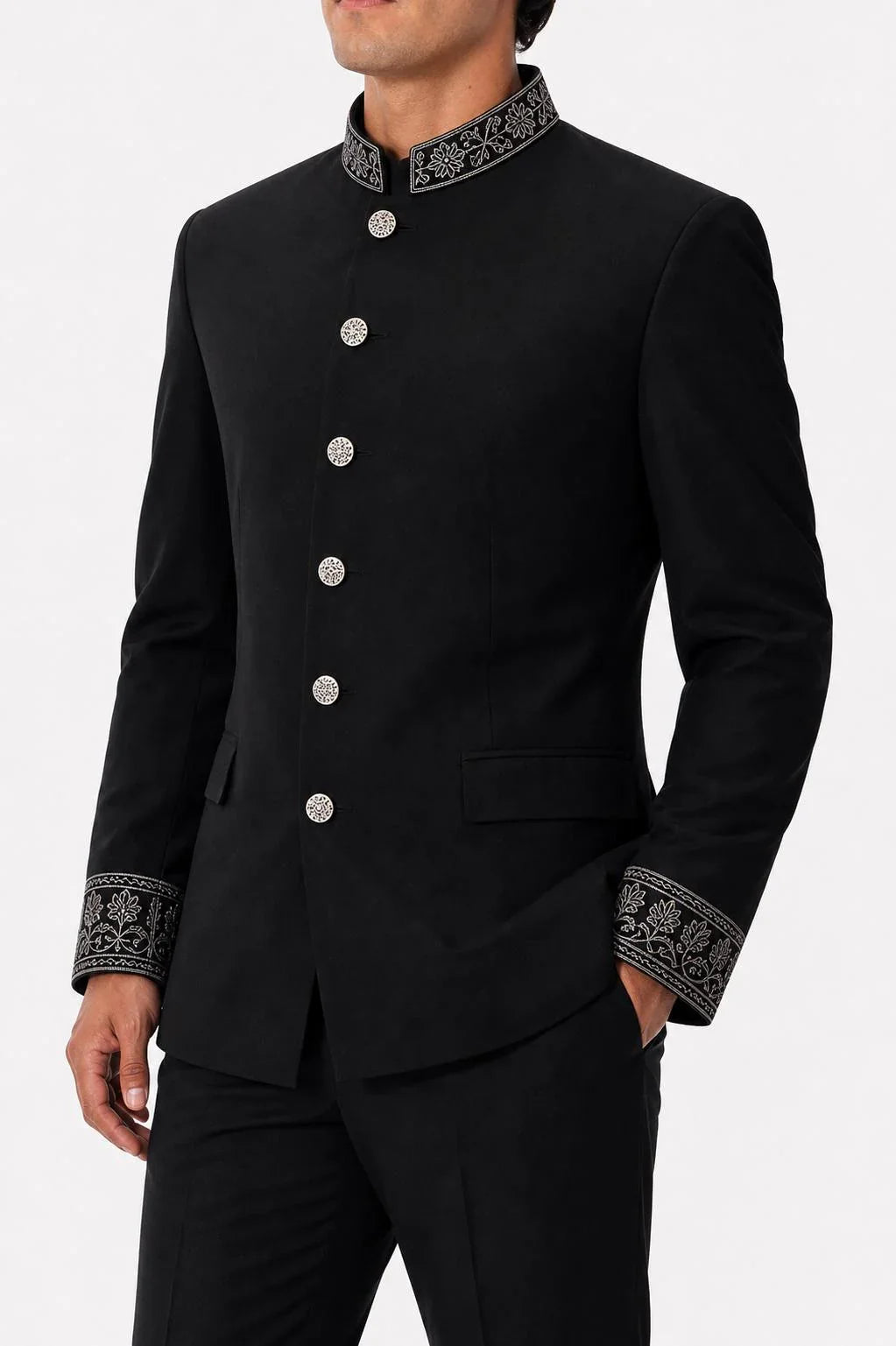
Choosing what to wear for an Indian wedding can be surprisingly complicated. There are traditional sherwanis, Bandhgalas, Jodhpuri suits, Nehru jackets, Indo-Western outfits, and Western suits—and each creates a very different impression.
Two of the most popular choices are the Sherwani and Bandhgala.
Both can look sophisticated and ceremonial, but they are designed for different purposes. A sherwani generally has a longer silhouette and a stronger traditional character, while a Bandhgala offers a more structured, tailored appearance that can transition easily between formal, wedding, and semi-formal occasions.
So, which should you choose?
The answer depends on the ceremony, your role in the wedding, the venue, the season, and how traditional or contemporary you want your outfit to feel.
This guide compares Sherwani vs Bandhgala in detail so you can make a confident choice.
| Feature | Sherwani | Bandhgala |
|---|---|---|
| Silhouette | Long and structured | Shorter tailored jacket |
| Collar | Usually high/closed | High/closed |
| Sleeves | Full sleeves | Full sleeves |
| Overall style | Traditional and ceremonial | Modern Indian formalwear |
| Best for | Main wedding ceremonies | Receptions, engagements, formal events |
| Embroidery | Often more prominent | Usually subtle or optional |
| Trousers | Churidar, trousers or traditional bottoms | Tailored trousers |
| Versatility | Primarily formal | Highly versatile |
| Western influence | Lower | Higher |
| Everyday wear | Limited | More practical |
There can be variations, and modern designers often blend elements of both styles.
A sherwani is a long, structured Indian garment traditionally worn for formal occasions.
It generally extends below the waist and may reach toward the knees or lower depending on the design.
Common features include:
For a groom, the sherwani can create a strong traditional presence and works especially well for the main wedding ceremony.
A Bandhgala is a structured Indian formal jacket characterized by its closed or high collar.
Unlike the longer sherwani, a Bandhgala generally has a shorter jacket silhouette similar in length to a conventional tailored jacket.
It can be worn with:
Tailored trousers
Matching trousers
Chinos in casual interpretations
Traditional trousers
Occasionally a kurta
A Bandhgala can be minimalist and contemporary or highly decorative and ceremonial.
Its versatility makes it popular for weddings, receptions, engagement parties, formal dinners, cultural events, and even certain business environments.
The easiest way to distinguish the two is the silhouette.
A sherwani is long.
A Bandhgala is comparatively short and jacket-like.
This difference changes the overall visual impression.
The sherwani creates a more traditional, regal, and ceremonial appearance.
The Bandhgala creates a cleaner, sharper, more contemporary tailored appearance.
Neither is inherently more formal. They simply communicate formality differently.
The groom's role is one of the most important factors when choosing between the two.
A sherwani is particularly suitable when you want your wedding outfit to feel traditional and ceremonial.
It works especially well for:
Hindu wedding ceremonies
Sikh wedding ceremonies
Muslim wedding celebrations
Traditional Indian ceremonies
Palace or heritage venues
Large formal weddings
Rich embroidery, brocade, jacquard, silk blends, or other luxurious fabrics can enhance the ceremonial character.
A Bandhgala is ideal if you prefer a cleaner and more contemporary appearance.
It can be styled with:
Solid wool
Velvet
Jacquard
Textured fabric
Minimal embroidery
Statement buttons
For grooms who want something they can wear again after the wedding, the Bandhgala often offers greater versatility.
For a highly traditional ceremony, a sherwani will usually create the stronger ceremonial look.
The longer silhouette, traditional construction, and opportunity for detailed embroidery make it particularly appropriate for the main wedding event.
However, this isn't a strict rule.
A beautifully tailored Bandhgala can also work for a wedding ceremony, particularly when the wedding has a modern or minimalist aesthetic.
The decision should ultimately reflect the wedding's overall style.
The Bandhgala can be an excellent reception choice.
A dark velvet, navy, black, burgundy, or deep green Bandhgala can create a sophisticated evening appearance.
For a more traditional reception, a sherwani can also work beautifully, particularly when the event calls for formal Indianwear.
Consider the venue and dress code before choosing.
A sherwani can be worn for an engagement, but it may feel more ceremonial than necessary depending on the event.
For a contemporary engagement, a Bandhgala or Nehru jacket may provide a lighter and more versatile option.
For a large traditional engagement celebration, however, a richly detailed sherwani can be appropriate.
The Bandhgala is particularly strong for engagement parties.
A minimalist navy, beige, charcoal, burgundy, or deep green Bandhgala can create a polished appearance without looking overly ceremonial.
Pair it with tailored trousers and formal shoes for a modern Indian formalwear look.
Guests generally have more freedom than the groom.
A sherwani can work for close family members and guests at particularly traditional weddings.
However, guests should generally avoid designs that are too elaborate if the groom is wearing a highly decorated sherwani.
A Bandhgala is one of the safest choices for a wedding guest.
It looks formal without necessarily appearing like groomwear.
Good colors include:
Navy
Charcoal
Grey
Brown
Deep green
Burgundy
Choose subtle textures or patterns if you want additional visual interest.
Both options can work.
A father of the groom may prefer a Bandhgala because it provides a sophisticated formal appearance without competing with the groom.
For a traditional wedding, a more elaborate sherwani can also be appropriate.
The most important consideration is coordination.
The father's outfit should complement the wedding palette without looking identical to the groom's outfit.
For groomsmen, Bandhgalas can make excellent coordinated outfits.
The group can wear the same silhouette while varying:
Colors
Pocket squares
Buttons
Fabrics
Accessories
This creates coordination without requiring every person to look identical.
Traditional and modern sherwanis offer many color options.
One of the most popular groom colors.
It creates a refined and timeless wedding appearance.
Softer than bright white and particularly suitable for daytime ceremonies.
A luxurious choice for traditional weddings.
Works well for outdoor and daytime celebrations.
Soft pink, sage, powder blue, and other muted colors can create a contemporary groom aesthetic.
Navy, burgundy, emerald, and deep green are excellent for evening weddings.
The shorter silhouette of a Bandhgala works particularly well with solid colors.
Probably the most versatile option.
Ideal for evening receptions and formal events.
Sophisticated and understated.
Rich and festive.
Distinctive without being overly bright.
Excellent for daytime and summer events.
Fabric plays a major role in the appearance of a sherwani.
Creates a luxurious formal appearance.
Excellent for traditional wedding styling.
Adds texture and pattern.
Ideal for winter evening weddings.
Useful for warm-weather ceremonies when a lighter construction is preferred.
Bandhgalas offer even more flexibility.
Excellent for structured formalwear.
Ideal for winter evenings.
Suitable for summer events.
Useful for lighter and more relaxed styling.
Excellent for wedding and festive outfits.
Embroidery can dramatically change the personality of either garment.
Sherwanis traditionally accommodate more elaborate decoration.
You may see:
Floral embroidery
Paisley patterns
Metallic threadwork
Traditional motifs
Decorative borders
Bandhgalas can also feature embroidery, but a minimalist approach often works better.
For example, subtle embroidery around the collar or chest can add interest without overwhelming the tailored silhouette.
The Bandhgala is generally more versatile.
A Bandhgala can be worn to:
Weddings
Engagements
Receptions
Formal dinners
Cultural events
Business functions
Festive celebrations
A sherwani is primarily associated with weddings and other ceremonial occasions.
If you're investing in one garment that you hope to wear repeatedly, the Bandhgala may provide more opportunities.
The sherwani generally has a stronger traditional association.
Its longer silhouette and ceremonial styling make it immediately recognizable as formal Indian weddingwear.
The Bandhgala is also deeply connected to Indian menswear, but its shorter tailored structure gives it a more modern appearance.
Comfort depends more on construction, fabric, fit, and weather than on the garment name.
A poorly fitted sherwani can feel restrictive.
A poorly fitted Bandhgala can also restrict movement.
For weddings lasting many hours, pay particular attention to:
Shoulder fit
Armhole
Chest
Waist
Sleeve length
Fabric weight
Collar comfort
Trouser fit
A custom garment can be particularly useful when comfort is important.
A custom sherwani can be designed around your measurements and preferred silhouette.
This allows adjustments to:
Shoulder
Chest
Waist
Jacket length
Sleeve
Collar
Trouser dimensions
Embroidery placement
Button placement
This can be particularly valuable for grooms because wedding photographs capture the outfit from multiple angles.
The Bandhgala's structured shape also benefits from accurate tailoring.
A custom version allows you to determine:
Collar height
Jacket length
Waist shaping
Shoulder structure
Sleeve length
Trouser width
Button style
Fabric
Fit
The result can be designed specifically for your proportions.
Absolutely.
Modern Indian tailoring doesn't always need to follow strict categories.
You could create a longer Bandhgala-inspired jacket with sherwani-like detailing.
Or you could take a sherwani-inspired design and simplify the embroidery and construction for a contemporary appearance.
This is where custom tailoring becomes particularly useful.
Use the following checklist.
You want a traditional groom's outfit.
Your wedding ceremony is highly traditional.
You want a longer silhouette.
You enjoy embroidery and decorative details.
You're dressing for a formal cultural ceremony.
You want a strong ceremonial presence.
You prefer modern tailoring.
You want a shorter jacket.
You want something more versatile.
You prefer minimal decoration.
You're attending an engagement or reception.
You want an outfit you can wear beyond the wedding.
You don't necessarily have to choose completely traditional or completely modern.
An Indo-Western suit can combine elements from both worlds.
For example:
Bandhgala-style jacket + Western trousers + Indian-inspired fabric
or
Sherwani-inspired jacket + contemporary trousers + minimalist accessories
This can be particularly effective for multicultural weddings and destination weddings.
Both sherwanis and Bandhgalas depend heavily on proportion.
A garment can have beautiful fabric and embroidery but still look disappointing if:
The shoulders are too wide.
The sleeves are too long.
The collar is uncomfortable.
The jacket is too long or short.
The waist is too tight.
The trousers don't balance the jacket.
Custom tailoring allows the garment to be built around the individual rather than forcing the individual into a standard size.
At Indie Darzi, you can create a custom Indian formal outfit based on your measurements and personal style.
Whether you choose a sherwani, Bandhgala, Jodhpuri suit, Nehru jacket, or Indo-Western design, the focus is on creating a garment that fits your body and your occasion.
You can customize:
Fabric
Color
Collar
Buttons
Jacket length
Trousers
Fit
Embroidery
Lining
Finishing details
For a groom, this allows the outfit to coordinate with the wedding theme while remaining personal.
There isn't one universal winner.
Choose a Sherwani when tradition, ceremony, and a strong Indian wedding aesthetic are your priorities.
Choose a Bandhgala when you want tailored Indian formalwear with a cleaner, more contemporary silhouette and greater versatility.
For the main traditional wedding ceremony, a sherwani is often the natural choice.
For receptions, engagements, formal dinners, and modern wedding celebrations, a Bandhgala can be an excellent alternative.
And if you want something between the two, an Indo-Western design can combine the strongest elements of both.
Ultimately, the best wedding outfit is the one that fits your body, matches the occasion, and makes you feel confident.
Explore custom Indian formalwear with Indie Darzi and design a sherwani, Bandhgala, or Indo-Western outfit tailored specifically for you.
Both can be highly formal. A sherwani generally has a more ceremonial and traditional appearance, while a Bandhgala tends to have a cleaner tailored silhouette.
For a traditional main wedding ceremony, a sherwani is a natural choice. For an engagement, reception, or modern wedding, a Bandhgala can be an excellent alternative.
Yes. A Bandhgala can be worn by grooms, wedding guests, fathers of the groom, and groomsmen depending on the design and styling.
Yes. A sherwani can be appropriate for a formal reception, especially when the event has a traditional Indian dress code.
A Bandhgala is generally more versatile because it can be worn for weddings, receptions, dinners, cultural events, and certain professional occasions.
Either can work. A Bandhgala is often easier for guests because it provides a formal appearance without necessarily looking like traditional groomwear.
Yes. A custom sherwani can be adjusted for your measurements, preferred length, collar, fit, fabric, embroidery, buttons, and trousers.
Yes. Custom Bandhgala tailoring allows you to personalize the collar, shoulders, chest, waist, jacket length, sleeves, trousers, fabric, buttons, and overall fit.
Ivory, cream, beige, gold, pastel shades, navy, burgundy, and deep green can all work depending on the wedding, season, venue, and personal style.
Yes. Modern tailoring can simplify embroidery, use contemporary fabrics, introduce cleaner proportions, or combine Indian and Western elements to create a more contemporary outfit.


