Total: $0.00 USD
Taxes and shipping calculated at checkout


Indie Darzi specializes in made-to-measure men's suits, custom suits, tailor-made wedding suits, and premium formalwear crafted to your measurements.
Client: Ricarda Baselgia
Based in: Switzerland
Made in: India
Garment: Custom Embroidered Double-Breasted Suit
Fabric: Sky Blue
Embroidery: 15 Individual Motifs
Embroidery Pattern Development: 20+ Hours
Embroidery Production: Approximately 25 Days
International Delivery: 3–4 Days
Final Suit Cost: Under $349

Every custom project begins with an idea.
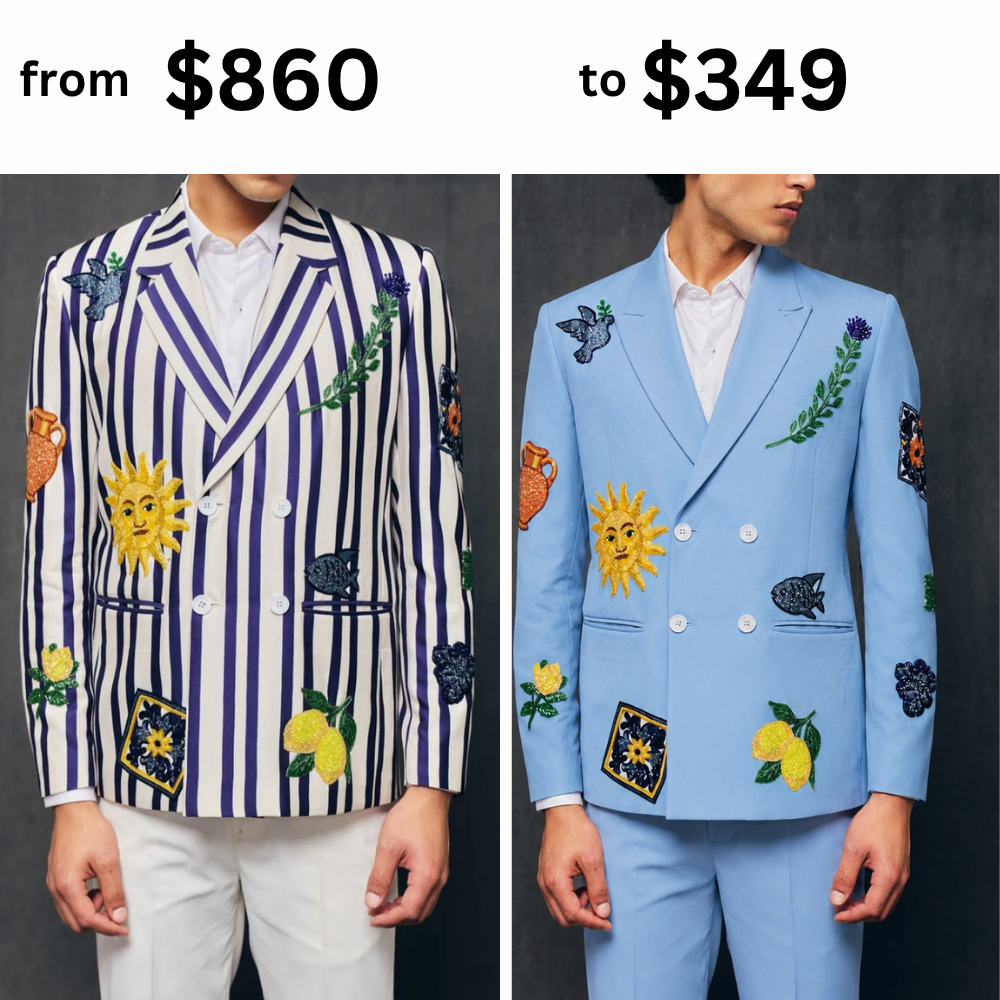
For Ricarda, that idea came from a very distinctive embroidered pinstripe suit from Perte D'ego.
The reference suit had a strong visual identity—bold stripes, colourful embroidered motifs and a statement-making silhouette.
The approximate cost of the original reference was:
Jacket: $600
Trousers: $110
Shipping: $150
Total: Approximately $860
But Ricarda wasn't simply looking for a standard-size suit.
They wanted something that would actually be made for their body and measurements.
That's where Indie Darzi came in.
Instead of purchasing the existing suit, we decided to take the concept and develop a new garment from scratch.
And the final result cost under $349 for the complete suit.
At first, the project seemed straightforward:
Find the fabric → recreate the design → make the suit.
It turned out to be anything but straightforward.
We faced several major challenges throughout the process.
The first major obstacle was the distinctive pinstripe fabric used in the reference.
We searched for a fabric that could reproduce the same look, but we weren't able to source the right material.
Rather than compromise the project with a fabric that wasn't right, we went back to Ricarda and discussed alternatives.
The decision was made to change direction.
It was a significant change, but it opened the door to something more personal.
The new sky-blue fabric became the foundation for the embroidery and ultimately gave the finished suit its own identity.
The reference suit was based on a standard/vanity sizing system.
Our approach was completely different.
We didn't want to select a size and make adjustments simply.
We wanted to build the garment around Ricarda's actual measurements.
That meant developing the suit from the beginning with the customer's proportions in mind.
The jacket, sleeves, length, trousers, and embroidery placement all had to work together.
This was particularly important because the embroidery wasn't an afterthought.
It was part of the design of the garment itself.
The new sky-blue fabric solved the first problem.
But it created another one.
The reference featured a large collection of colourful embroidered motifs, and we wanted to preserve that visual language while making it work on the new garment.
There were 15 different embroidery designs to reproduce.
Birds.
Flowers.
Plants.
Fish.
Sun.
Fruit.
Decorative patches.
Each design had to be considered individually.
But the difficult part wasn't simply creating the embroidery.
It was determining exactly where every motif should go and how large it should be.
Before the embroidery machine could even start, we spent approximately 20 hours drafting and planning the embroidery patterns.
We had to account for:
A design that looks perfect on a screen can look completely wrong when placed on a real jacket.
So every motif had to be planned around the actual garment.
It was less like simply decorating a suit and more like solving a three-dimensional puzzle.

Once the designs and placements were planned, we still weren't ready to embroider.
The artwork had to be converted into digital embroidery files that could be understood by the industrial embroidery machine.
We developed the required PES embroidery files and supporting production files.
This process determines how the machine interprets the artwork—including the structure, stitching and sequence required to turn a digital design into embroidery on fabric.
And because there were 15 separate motifs, this had to be done repeatedly.
The goal was consistency.
Every motif needed to have the right proportions, density and overall appearance.

This was probably the most stressful part of the entire project.
The industrial embroidery machine began experiencing problems.
It stopped working multiple times during production.
And this wasn't a small project with one simple logo.
We had 15 different embroidery designs to complete.
Every machine failure meant another interruption.
Another delay.
Another uncertainty about when we could continue.
At some points, after investing so much time into the project, we genuinely started losing hope.
But we couldn't simply rush the embroidery.
The designs were too detailed, and the final suit depended on them being done correctly.
So we kept working.
During the project, Ricarda asked whether the embroidery could be done by hand.
It was a fair question.
But for this particular design, we believed industrial embroidery was the better solution.
There were 15 separate motifs, each requiring consistency and a clean, controlled finish.
Hand embroidery would have been considerably more time-consuming, and achieving the same level of consistency across all of the motifs would have been extremely difficult.
So we stayed with the industrial embroidery process.
Even when it became frustrating.
Even when the machines weren't cooperating.
We wanted the finish to be right—not simply fast.

The embroidery process eventually took approximately 25 days.
Not 25 days because the embroidery itself was supposed to take that long.
It took that long because of the complexity of the project, multiple motifs, production interruptions and repeated machine problems.
But eventually, the moment arrived.
All 15 motifs were ready.
The biggest technical hurdle of the project was finally behind us.
Now we could start putting the garment together.
With the embroidery completed, we moved into the tailoring stage.
The sky-blue fabric was transformed into the structure of the suit.
The jacket was constructed around the customer's measurements, with the embroidery integrated into the overall design.
This meant that the embroidery, buttons, pockets, seams and proportions all had to work together.
The goal was not to make the embroidery look like something simply placed on top of a jacket.
We wanted the entire garment to feel intentional.
The tailoring and embroidery had to belong to the same design.

Once the suit was fully constructed, there was still one important finishing step.
During the tailoring process, chalk marks are used for drafting, marking and construction.
Before shipping the suit internationally, we wanted the garment to look completely clean.
So we sent it for professional dry cleaning to remove the remaining chalk marks and prepare the suit for its final presentation.
Once it came back, the difference was immediately visible.
The marks were gone.
The fabric looked fresh.
The embroidery stood out beautifully against the sky-blue base.
And the suit finally looked like the finished piece we had imagined at the beginning.
Before shipping the suit, we photographed and filmed the finished garment.
We sent the pictures and video to Ricarda in Switzerland.
After all the challenges we'd faced—the fabric change, the embroidery planning, digital file development, machine failures and 25-day embroidery process—we finally received the response we had been hoping for.
For us, that was one of the most rewarding moments of the entire project.
Because a custom garment isn't truly finished when the tailor finishes sewing.
It's finished when the customer sees it and knows it was worth the wait.

The finished suit was carefully prepared and shipped from India to Switzerland.
Despite the international distance, delivery took approximately 3–4 days.
And after weeks of development and production, the suit was finally in Ricarda's hands.
The journey was complete.
But the story wasn't.
The original reference suit had an approximate total cost of $860.
Our completed custom suit came in at under $349.
But the most important difference wasn't simply the price.
It was what the customer received.
Approx. $860
Under $349
The result wasn't simply a lower-cost alternative.
It became a completely new garment, created specifically for the customer.

The most meaningful part of the project came after delivery.
Ricarda didn't simply receive the suit and move on.
After experiencing the finished garment and the process behind it, they came back to Indie Darzi with another order.
And this time, the project was even more important.
That meant more to us than simply receiving another order.
It meant the customer trusted us with something that would be part of one of the most important occasions of their life.
The first suit earned the second project.
And for a custom tailor, there may be no better sign that the work has done its job.

| Detail | Project |
|---|---|
| Client | Ricarda Baselgia |
| Country | Switzerland |
| Made in | India |
| Garment | Custom Embroidered Suit |
| Original Reference Cost | Approx. $860 |
| Indie Darzi Cost | Under $349 |
| Fabric | Sky Blue |
| Embroidery Designs | 15 Individual Motifs |
| Embroidery Planning | 20+ Hours |
| Embroidery Production | Approx. 25 Days |
| Construction | Made from scratch |
| Fit | Customer's measurements |
| Delivery | Approx. 3–4 Days |
| Next Project | Custom 3-Piece Wedding Suit |
Some projects are easy.
Some projects test everything.
This was one of the latter.
We learned that a custom garment isn't just about having the right measurements or knowing how to operate a sewing machine.
It is about finding solutions when the original plan doesn't work.
The original fabric wasn't available.
So we changed the fabric.
The embroidery required extensive planning.
So we spent 20+ hours developing it.
The machine stopped working.
So we waited, repaired, adjusted and continued.
The embroidery took 25 days.
So we didn't compromise the finish simply to finish faster.
And eventually, the suit reached Switzerland.
The original suit gave Ricarda the inspiration.
But it didn't define the final garment.
The finished suit became a collaboration between the customer's idea and our tailoring process.
A different fabric.
A different fit.
A different production journey.
And ultimately, a garment made specifically for one person.
You don't have to choose something that already exists.
You can start with an idea—and build from there.
Have a suit you've seen somewhere?
A vintage design?
A photograph?
An unusual embroidery?
A particular silhouette that you can't find in standard sizing?
Bring us the reference.
At Indie Darzi, we can work with you to develop the idea into a custom garment built around your measurements and your requirements.
Have an idea in mind? Let's make it real.
[Start Your Custom Order]


